“Living with an Adult Son Who Has a Traumatic Brain Injury (TBI)”
by Renée J. Lukas
On January 2, 2010, the world stopped. It was one of those snow-covered, quiet days, except for the snowmobiles rumbling across the frozen lake near our house.
Our oldest son Tucker, age 13 at the time, was on a snowmobile and crashed into the side of a house going 40+ mph when he accidentally accelerated. My partner and I were having lunch when the phone rang. All I heard her say was, “Which one? Is he dead?” Her voice was odd.
We raced out to the snowy area where it happened. I stood knee-deep in the snow, as my partner ran around the corner of the house to view the scene. A quick thinking EMT packed snow around Tucker’s head to prevent swelling in his brain, but the odds weren’t good. No one wanted to tell us, but we knew there were doubts as to whether or not he’d make it. Because of bad weather, they weren’t able to airlift him to the hospital. I remember my partner and I in the car, closely hugging the back of a speeding ambulance all the way to the hospital. We were in full-on adrenaline, survival mode. I don’t remember anything we said to each other on the way there.
At the time, gay marriage wasn’t legal, but we were partners in every sense. We waited and prayed together. Because Tucker is my partner’s son from her previous marriage to a man, only she and Tucker’s father were allowed to stay in the private room to hear what the doctor had to say about the severity of Tucker’s condition. I had to wait outside in the hall, wondering what was being said and knowing that I couldn’t console her if the worst had come to pass. It was the longest several minutes of my life.
They put Tucker in an artificially induced coma and monitored his condition. We watched him lying motionless in the ICU for weeks.
We learned that Tucker had suffered a Traumatic Brain Injury, or TBI.
Fast forward to the rehab hospital where he had to relearn how to swallow, speak, walk, even write his name. We played so many card games I’m now triggered whenever someone mentions Uno or Four King’s Corner. Before Tucker’s speech improved, he’d use a letter board, and, when asked how he was feeling, would sometimes spell out words I can’t repeat here. Throughout it all, his sense of humor was not only intact, but sharp as ever. We took that as a good sign of his cognitive abilities. The physical prognosis was a bit dimmer. He came home in a wheelchair, and a physical therapist told us it was unlikely he’d ever walk again.
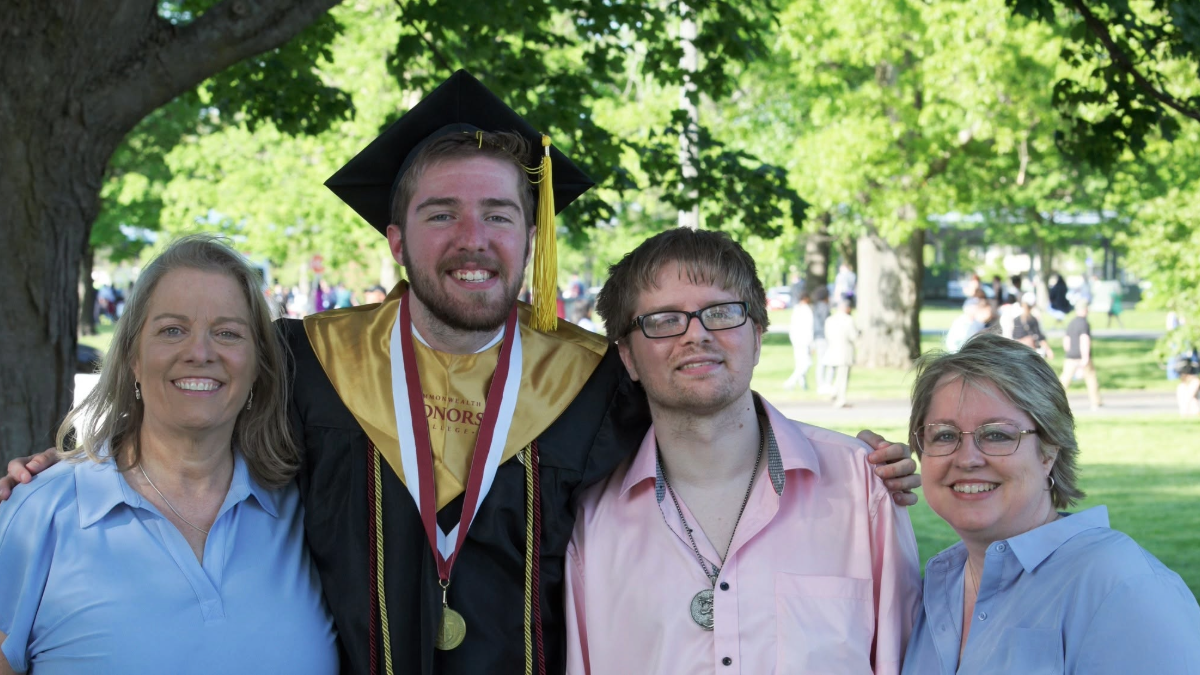
A few years later, Tucker graduated from high school and walked up the aisle himself to sit with his class and receive his diploma.
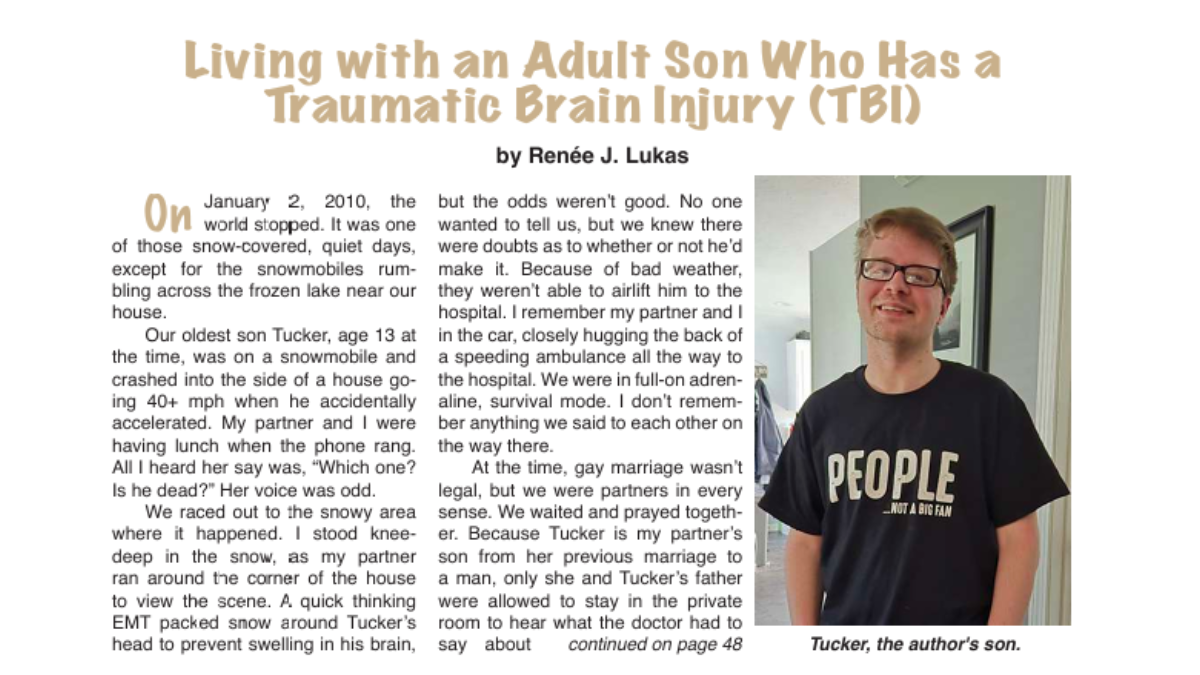
Today, at age 28, Tucker continues to walk. He has a part-time job and frequently helps me with my technical computer problems. He’s an intelligent, funny, sensitive and very perceptive human being. He often notices when I or my now wife is in a bad mood without a word being spoken. He has a high degree of emotional intelligence beyond most people I know. His sense of humor and biting sarcasm are legendary among his co-workers at work. I think he gets away with some unfiltered comments because of what happened to him, and Tucker wouldn’t have it any other way. Instead of avoiding talking about the accident, he leans into it, sometimes joking that now he can do whatever he wants because he’s “already cheated death once”. Technically, Tucker has cheated death twice, if you count the stormy night when a tree fell through his bedroom and barely missed his head. It’s hard to argue with someone about doing something for their safety when they remind you how death has eluded them.
Tucker doesn’t care if his story inspires people—and if he does care, he won’t tell you.
Aside from his labored speech and a zig-zagging sort of walk, you might not realize that anything happened. But it did. A TBI is something you’re reminded of every day. It’s not like a broken leg that heals. Or a disease that’s cured. It’s with him, and us, every day.
For Tucker, the TBI mostly affected his frontal lobe, which controls judgment, decision making and motivation, among other things. For this reason, he’s not really concerned with his health or safety. He goes to doctors’ appointments grudgingly.
After getting his ears cleaned out, we asked how he felt.
“It’s good and bad,” he said. “Good, but also bad because now I can hear you and Mom.”
When the laughter subsides, his mother and I know we’re living in a judgmental world, and we know he’s being judged even more because of his accident. Sometimes we try to get out ahead of that, yet sometimes it’s best to leave it alone. We walk a fine line between letting him be a young adult who will make his own mistakes and knowing when to step in.
This is the toughest part of being parents of someone with a TBI. No TBI is the exact same—the brain is still super mysterious, so what affects one person may not affect another. As a parent, you have to learn what things are being exaggerated and what is the truth. You have to learn how to nudge someone who insists they “don’t care” about virtually everything. And you have to not internalize the negativity of the person with the TBI. Not easy tasks.
I asked Tucker what it was like living with two lesbian moms. “Well,” he said, “you love and respect me, so that’s all I care about. It was weird at first when I was eleven, and my mom was crying, telling me she was gay. So she likes girls, I thought. So do I!” He saw it as something they had in common. He also liked that living with two women has helped him get the female perspective when it comes to dating.
Like many young men his age, online dating is the most prevalent way to connect—even more so with Tucker, because he doesn’t drive. Aside from work, there aren’t many situations where he might meet women organically. My wife and I worry about whether the online world will make him feel more isolated, as we both grew up in a time when you had no choice but to pick up the phone.
On the Internet, people can be cowardly and simply ghost you instead of responding. Tucker has had his share of heartbreaks, as well as some surprising connections.
When he first put his profile online, he said, “Must be okay with LGBTQ people.” I asked him why this was on his list of non-negotiables.
“I feel like I’m an ally,” he said. “I don’t want someone to be uncomfortable around my family. No tension. Because you guys are just people. I never understood people’s issues with it.”
Tucker is very astute, and he believes it’s because of his high school days. “When I came back to school in a wheelchair,” he says, “I was invisible to most people. Because people don’t know you’re there, you see and hear a lot, so you get in-tune with things.”
Navigating resources has been especially challenging for his mother and me. This is because Tucker’s TBI is somewhere in the middle—not severe enough that he can’t work part-time, but impactful enough that he still needs help with many daily tasks. We try to meet him where he is with most situations—sometimes it’s the right thing, sometimes not. We know we don’t have all the answers.
Most people don’t want to be defined by a single event. But sometimes I think the accident does define Tucker, because it’s given him a singular outlook that he may not have otherwise had. It’s shaped so much of what he believes and how he lives his life. As parents, it’s hard to let him make his own mistakes, as it would be with any son or daughter. Only with Tucker, the mistakes are often directly connected to his injury, and the desire to protect him can outweigh everything else.
When asked about his accident and how it affected his outlook on life, Tucker says, “That saying, you never know what you have ‘til it’s gone. I really feel that. I took walking and sports for granted.” And since the accident, others’ demands are the last on his list of priorities. “Now I don’t care about things other people want from me,” Tucker says. “I got a second chance, so I’m going to live my life my way.”
As parents, we try to let him do that as much as we can and hope for the best.